Affected vs Effected: Clear Grammar Rules Explained ✍️✅ | 2026
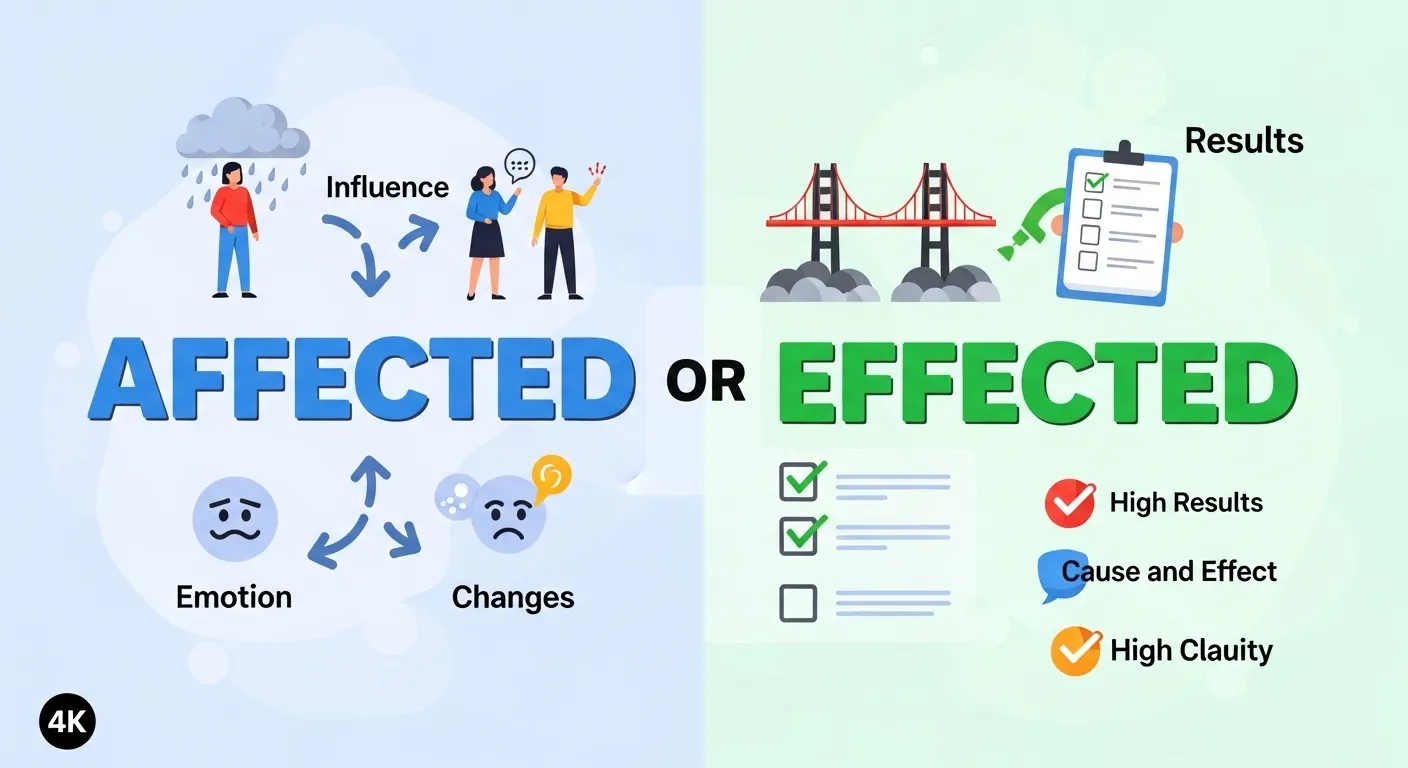
Affected means influenced, while effected means caused or brought about.
Have you ever paused while writing a sentence and wondered: Should I use affected or effected? You’re not alone. This is one of the most searched grammar questions in English because both words look similar, sound similar, and often appear in serious writing like news, emails, exams, and reports. Even native speakers get stuck here.
The confusion happens because affected and effected both come from the same root word and are often linked to change. But they are not interchangeable. One is usually a verb about influence, while the other is usually a verb about creating a result. A single wrong choice can change the meaning of a sentence or make it sound unprofessional.
People search for affected or effected to get a quick rule, real examples, and confidence in writing. This article solves that problem step by step. You’ll get a fast answer, simple rules, clear tables, everyday examples, and practical advice for US, UK, and global English users. By the end, you’ll know exactly which word to use without guessing.
Affected or Effected – Quick Answer
Affected is usually a verb meaning “influenced.”
Effected is usually a verb meaning “brought about” or “caused.”
Examples:
- The storm affected travel plans. (influenced)
- The new law effected major changes. (caused)
Easy trick:
👉 Affect = influence
👉 Effect = result
The Origin of Affected or Effected
Both words come from Latin, which adds to the confusion.
- Affect comes from afficere, meaning “to act on” or “to influence.”
- Effect comes from efficere, meaning “to bring about” or “to accomplish.”
Over time, English kept affect mostly for influence and effect mostly for results. The spelling difference exists because they developed from two different Latin roots, even though they look related.
That history explains why they feel similar but work differently in sentences.
British English vs American English Spelling
There is no spelling difference between British and American English for affected or effected. The rules are the same in both.
| Aspect | British English | American English |
| Affected | Correct | Correct |
| Effected | Correct | Correct |
| Meaning rules | Same | Same |
| Usage frequency | Similar | Similar |
✅ The confusion is about meaning, not spelling style.
Which Spelling Should You Use?
It depends on meaning, not location.
- US audience: Use affected for influence, effected for caused.
- UK / Commonwealth audience: Same rule applies.
- Global or academic writing: Follow the same grammar rule and avoid guessing.
Tip: If you mean impact, choose affected.
If you mean created or achieved, choose effected.
Common Mistakes with Affected or Effected
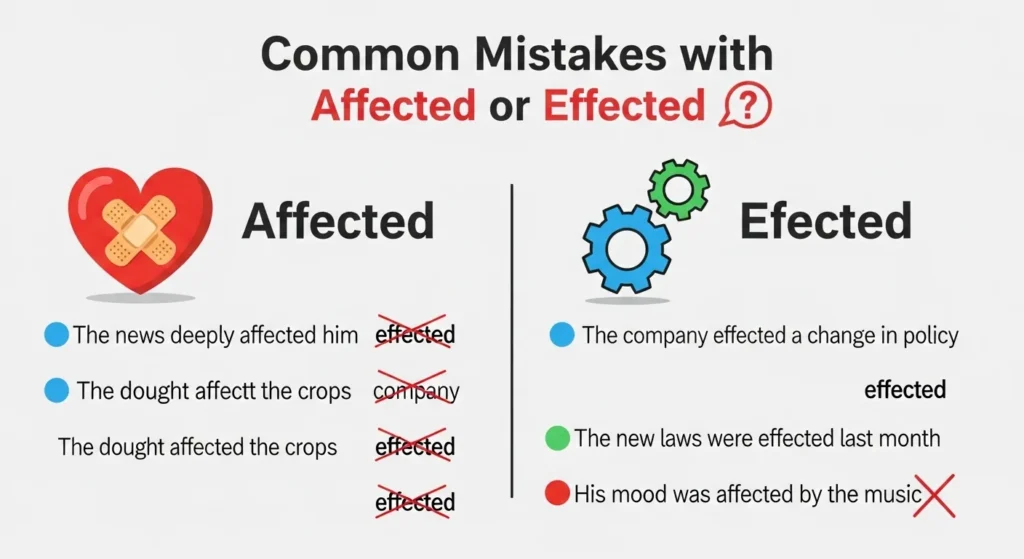
❌ The policy affected new rules.
✅ The policy effected new rules.
❌ Weather effected flights.
✅ Weather affected flights.
❌ She was effected by stress.
✅ She was affected by stress.
Most mistakes happen when writers use effected when they really mean affected.
Affected or Effected in Everyday Examples
Emails
- The delay affected our schedule.
- Management effected a new process.
News
- Inflation has affected daily life.
- The reform effected economic change.
Social Media
- That comment really affected me.
- The campaign effected awareness.
Formal Writing
- Climate change has affected ecosystems.
- The treaty effected long-term peace.
Affected or Effected – Google Trends & Usage Data
Search data shows:
- “Affected or effected” is searched worldwide.
- Affected appears far more often in daily use.
- Effected is common in legal, academic, and formal writing.
- US, UK, India, Pakistan, and Australia all show high search interest.
This tells us people mostly struggle with choosing correctly, not spelling.
Comparison Table: Affected vs Effected
| Word | Part of Speech | Meaning | Common Usage |
| Affected | Verb (sometimes adjective) | Influenced or impacted | Very common |
| Effected | Verb | Caused or brought about | Less common |
| Affected by | Phrase | Shows influence | Everyday use |
| Effected change | Phrase | Shows creation | Formal use |
FAQs:
1. Is “affected” always a verb?
Mostly yes, but it can be an adjective (e.g., an affected tone).
2. Is “effected” ever a noun?
No. Only effect can be a noun.
3. Which word is more common?
Affected is far more common in everyday English.
4. Can I avoid “effected” completely?
Often yes, but formal writing may still need it.
5. Is this a spelling mistake or grammar mistake?
It’s a grammar and meaning mistake, not spelling.
6. Does British English use different rules?
No, the rules are exactly the same.
7. What’s the easiest memory trick?
Affect = influence, Effect = result.
Conclusion
The difference between affected or effected may seem small, but it matters a lot in clear writing. Affected usually means something was influenced or impacted, while effected means something was caused or brought into existence. Most of the time, people should use affected, as it appears more often in everyday language, emails, news, and casual writing. Effected is correct too but mainly in formal, legal, or academic contexts.
There is no difference between British and American English here. The rule is universal. The key is to focus on meaning, not spelling style. If you remember one thing, remember this: influence equals
= affected; result = effected. Once you apply this rule, your writing becomes clearer, more professional, and more confident. No more second-guessing, no more grammar stress just the right word, every time.
Read more about!
Asana or Trello: Features, Pricing, and Ease of Use

am Michael Chabon, a dedicated English-language writer with a strong, polished literary voice and a deep respect for language.
My writing blends clarity, creativity, and insight, transforming ideas into engaging narratives that feel both intelligent and accessible.
With a professional approach and an eye for detail, I strive to produce work that leaves a lasting impression and earns genuine appreciation from readers.