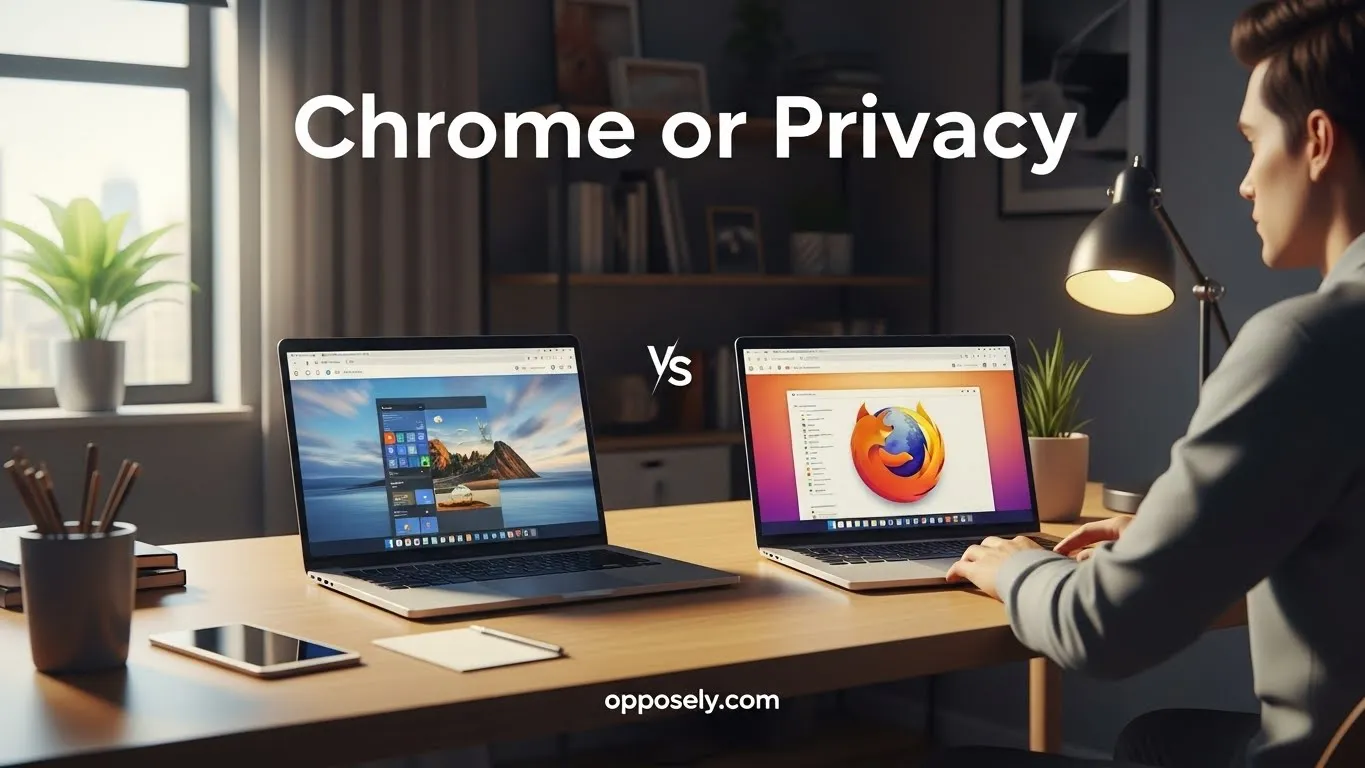
If you’re choosing a web browser, you’ve probably found yourself asking the same question many others do: Chrome or Firefox?
The short and honest answer is simple, Chrome is best for speed, convenience, and broad compatibility, while Firefox focuses more on privacy, customization, and user control.
Both browsers are powerful and reliable, but they are built with different priorities in mind. Your choice can affect how quickly websites load, how your personal data is handled, and how much control you have over your browsing experience.
That’s why so many people search for Firefox or Chrome , since both are free, widely trusted, and available on almost every device. At first, the differences may seem minor or even confusing. However, once you understand what each browser does best, the decision becomes much easier.
In this guide, I’ll break everything down clearly so you can choose the browser that truly fits your daily needs.
Chrome or Firefox: Quick Answer
Google Chrome focuses on speed, simplicity, and seamless integration with Google services.
Mozilla Firefox focuses on privacy, transparency, and customization.
Quick example:
If you rely on Gmail, Google Docs, and extensions → Chrome
If you value privacy and control → Firefox
What Is Google Chrome?
Google Chrome is the most widely used web browser in the world.
It was launched by Google in 2008 and quickly became popular because of its speed and clean design.
Chrome is designed to work perfectly with:
- Google Search
- Gmail
- YouTube
- Google Drive
It updates automatically and works smoothly across devices.
Strengths of Chrome
- Very fast performance
- Excellent website compatibility
- Large extension library
- Strong syncing across devices
What Is Mozilla Firefox?
Mozilla Firefox is an open-source browser created by the Mozilla Foundation.
Unlike Chrome, Firefox is not owned by a large advertising company.
Firefox puts user privacy and freedom first.
It blocks many trackers by default and gives users more control over their data.
Strengths of Firefox
- Strong privacy protection
- Open-source and transparent
- Highly customizable
- Less data tracking
Chrome vs Firefox: Performance Comparison
Both browsers are fast, but Chrome usually loads pages slightly quicker, especially on websites built for Google services.
Firefox performs very well too, especially on systems with limited resources.
Performance Summary
| Feature | Chrome | Firefox |
|---|---|---|
| Speed | Very fast | Fast |
| RAM Usage | Higher | Lower |
| Startup Time | Quick | Slightly slower |
| Stability | Excellent | Excellent |
Privacy: Chrome or Firefox?
This is where Firefox clearly stands out.
Chrome is developed by Google, a company that earns money through advertising.
While Chrome is secure, it collects more usage data.
Firefox blocks many trackers by default and allows deeper privacy customization.
Privacy Comparison
| Privacy Feature | Chrome | Firefox |
|---|---|---|
| Tracker Blocking | Limited | Strong (default) |
| Data Collection | Higher | Lower |
| Open Source | No | Yes |
| Privacy Controls | Basic | Advanced |
Extensions and Add-Ons
Chrome has the largest extension store in the world.
Almost every tool you can think of is available for Chrome.
Firefox also has many extensions, though fewer than Chrome.
However, Firefox allows deeper customization through add-ons.
Extension Support
| Aspect | Chrome | Firefox |
|---|---|---|
| Number of Extensions | Very large | Large |
| Customization Level | Moderate | High |
| Developer Support | Strong | Strong |
Security: Which Is Safer?
Both browsers are very secure.
Chrome uses sandboxing and frequent updates to protect users.
Firefox uses similar security measures and adds stronger tracking protection.
Neither browser is unsafe when kept updated.
Resource Usage: RAM and Battery
Chrome is known for using more RAM, especially with many tabs open.
Firefox generally uses less memory and feels lighter on older systems.
Resource Usage
| Resource | Chrome | Firefox |
|---|---|---|
| RAM Usage | High | Lower |
| Battery Impact | Higher | More efficient |
| Best for Older PCs | No | Yes |
Chrome or Firefox for Different Users
Students
- Chrome for Google Classroom and Docs
- Firefox for focused, distraction-free browsing
Professionals
- Chrome for cloud tools and teamwork
- Firefox for privacy-focused research
Developers
- Chrome for testing and debugging
- Firefox for standards-based development
Chrome or Firefox on Mobile
Both browsers are available on Android and iOS.
Chrome syncs perfectly with Google accounts.
Firefox offers stronger mobile privacy and tracking protection.
Customization Options
Firefox allows users to deeply customize:
- Themes
- Layout
- Privacy settings
Chrome keeps things simple and minimal.
Common Mistakes People Make
- Thinking Chrome is unsafe
- Assuming Firefox is slow
- Ignoring RAM usage
- Choosing without testing
- Using outdated versions
Both browsers improve constantly.
Chrome or Firefox in Everyday Use
Email:
“I prefer Firefox for private browsing.”
Office Talk:
“Chrome works best with our tools.”
Tech Support:
“Clear cache in Chrome or Firefox.”
Google Trends & Popularity
Chrome dominates global usage.
Firefox maintains a loyal user base, especially among privacy-conscious users.
Searches for Chrome or Firefox increase when:
- New browser updates launch
- Privacy concerns trend
- New devices are released
FAQs
Is Chrome faster than Firefox?
Usually yes, but the difference is small.
Is Firefox safer than Chrome?
Firefox offers stronger privacy controls.
Which browser uses less RAM?
Firefox.
Can I use both?
Yes, many people do.
Which is better for privacy?
Firefox.
Which is better for Google services?
Chrome.
Conclusion
So, when choosing Chrome or Firefox, the best option really depends on what matters most to you. If you want speed, simplicity, and smooth integration with Google services, Chrome is the right choice.
If privacy, transparency, and greater control over your data are more important, Firefox is the better option. Neither browser is wrong, they’re simply built for different users and different priorities.
Once you understand these differences, the decision becomes much easier. From then on, when someone asks Chrome or Firefox, you’ll know exactly which one fits your needs and why.
Read More:
Real or Not: Meaning, Examples and Mistakes
Primary or Secondary: Meaning, Examples and Mistakes
Less or Equal: Meaning, Origin and Usage(2026)