Have you ever typed “die or dye” and wondered which is right? You’re not alone. These two words sound the same but have completely different meanings.
Using the wrong one can confuse readers or make your writing look unprofessional.
Whether you’re a student, blogger, or writer, knowing the correct usage is essential.
In this article, we’ll cover everything about die and dye: their meanings, origins, differences, common mistakes, examples, and tips for correct usage.
By the end, you’ll confidently use both words in the right context.
Die or Dye: Quick Answer
Quick Answer:
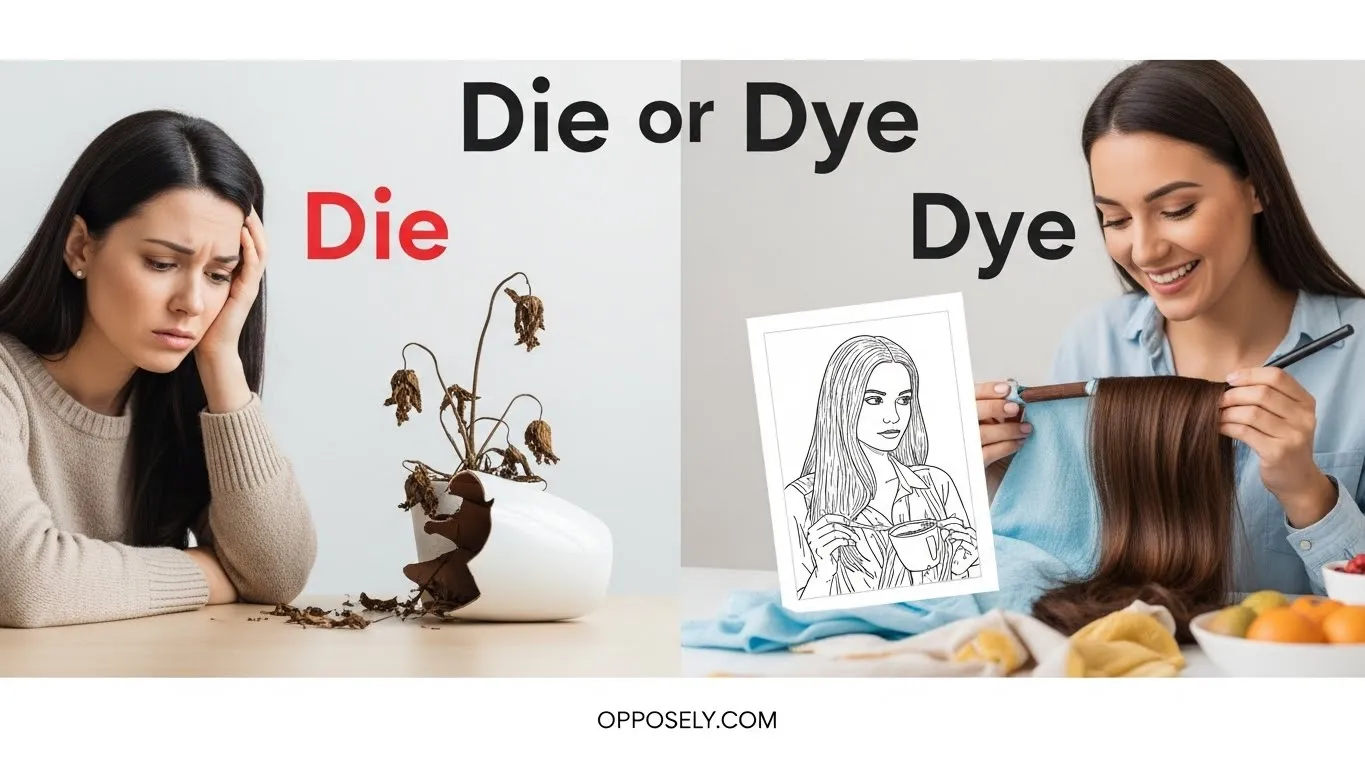
- Die – means to stop living or cease to exist.
- Dye – means to color something, usually fabric, hair, or food.
Examples:
- Correct: Plants die without water.
- Correct: She dyes her hair red every summer.
- Incorrect: Plants dye without water.
- Incorrect: She dies her hair red every summer.
Remember: If it’s about life ending, use die. If it’s about adding color, use dye.
The Origin of Die and Dye
Die
- Comes from Old English “dīegan”, meaning “to die or cease living.”
- It has been used for centuries in literature, religious texts, and common speech.
Dye
- Comes from Old English “dēag”, meaning “color or tint.”
- Originally used in the textile industry for coloring fabrics.
- Over time, it expanded to hair, food, and other materials.
Key Takeaway: Even though they sound the same (homophones), their origins and meanings are completely different.
Die vs Dye: British English vs American English
Both die and dye are spelled the same way in British and American English. There’s no regional difference in spelling.
| Word | Meaning | Usage (UK) | Usage (US) | Common Mistake |
|---|---|---|---|---|
| Die | To stop living | Used in general speech and writing | Same as UK | Dye instead of die |
| Dye | To color something | Fabric, hair, food | Same as UK | Die instead of dye |
Example Sentences:
- UK: Many plants die during winter. / She dyes her hair blonde.
- US: Old books die when neglected. / He dyes his shirts blue.
Which Word Should You Use?
- Die → Use for life, existence, machinery, plants, or anything ceasing to exist.
- Dye → Use for coloring materials like fabric, hair, or food.
Tip: Ask yourself: “Am I talking about death or color?” That’s the easiest way to choose.
Common Mistakes with Die and Dye
Many people confuse die and dye because they sound identical. Here are frequent errors:
- Writing “dye” instead of “die”
- ❌ I hope my plants dye in the sun.
- ✅ I hope my plants die in the sun.
- Writing “die” instead of “dye”
- ❌ She dies her hair black every month.
- ✅ She dyes her hair black every month.
- Confusing idioms
- ❌ Dieing for a haircut
- ✅ Dyeing for a haircut (if talking about hair color)
Quick Tip: Use context to decide:
- Die = end of life/existence
- Dye = adding color
Die or Dye in Everyday Examples
1. Emails
- Please water the plants, or they might die.
- I’m thinking of dyeing my hair purple next week.
2. Social Media
- RIP! My succulent finally died 😢
- Just dyed my hair pink! Love it 💖
3. News Articles
- Millions of coral reefs die each year due to climate change.
- Fashion brands dye fabrics using sustainable methods.
4. Formal Writing
- Many species die if their habitat is destroyed.
- The company dyes textiles with non-toxic materials.
Google Trends & Usage Data
- Die is searched more often in contexts related to health, gaming, technology (e.g., “CPU dies”), and plants.
- Dye is searched for fashion, hair, fabric, and food coloring.
Example Table:
| Word | Popular Searches | Context |
|---|---|---|
| Die | Plant dies, CPU dies, people die | Life, technology, nature |
| Dye | Hair dye, fabric dye, food dye | Coloring, fashion, cooking |
Keyword Variations Comparison
| Word | Correct? | Notes |
|---|---|---|
| die | ✅ | Used for life ending or ceasing |
| dye | ✅ | Used for coloring materials |
| dies | ✅ | Plural or third person form of die |
| dyes | ✅ | Plural or third person form of dye |
| dieing | ❌ | Incorrect, should be dying |
| dyeing | ✅ | Correct for coloring |
Advanced Tips for Using Die and Dye
- In Writing
- Always proofread to avoid mixing the words.
- Check context: death vs color.
- In Blogging
- Use “dye” when giving tutorials: “How to dye your hair naturally.”
- Use “die” in storytelling: “The old tree finally died last winter.”
- In Emails
- Keep sentences clear to avoid confusion.
- Example: “Be careful with the chemicals; they can dye your clothes.”
- In Social Media
- Emojis help: 💀 for die, 🎨 for dye.
- Example: Roses die quickly without water 💀
- Example: I just dyed my hair purple 🎨
- In SEO
- Pair keywords with context: “hair dye,” “plant dies,” “fabric dye,” etc.
- Helps search engines show accurate results.
FAQs:
Q1: Can “die” ever mean color?
- ❌ No. Use dye for color.
Q2: Can “dye” ever mean death?
- ❌ No. Use die for ending life.
Q3: What’s the plural of die?
- ✅ Dies (e.g., “The dies in the factory broke.”)
Q4: What’s the plural of dye?
- ✅ Dyes (e.g., “The lab tested different dyes.”)
Q5: Is “dieing” correct?
- ❌ No, the correct spelling is dying.
Q6: Can “dyeing” be used for hair?
- ✅ Yes, She is dyeing her hair red.
Q7: Are die and dye homophones?
- ✅ Yes, they sound the same but have different meanings.
Conclusion
In the die or dye debate, context is everything:
- Die → End of life, existence, or function.
- Dye → Adding color to fabric, hair, food, or materials.
Confusing these two words is common, but understanding their meanings, origins, and correct usage will make your writing professional and clear.
Always proofread your work, think about context, and remember the simple tip: “Die = life ends, Dye = color added.”
With practice, you’ll confidently use die and dye correctly in blogs, emails, social media, and formal writing.
Read More:
Foody vs Foodie: Spelling, Usage and examples
Edition or Addition: Quick Tips on Spelling, Meaning, and Usage

am Michael Chabon, a dedicated English-language writer with a strong, polished literary voice and a deep respect for language.
My writing blends clarity, creativity, and insight, transforming ideas into engaging narratives that feel both intelligent and accessible.
With a professional approach and an eye for detail, I strive to produce work that leaves a lasting impression and earns genuine appreciation from readers.