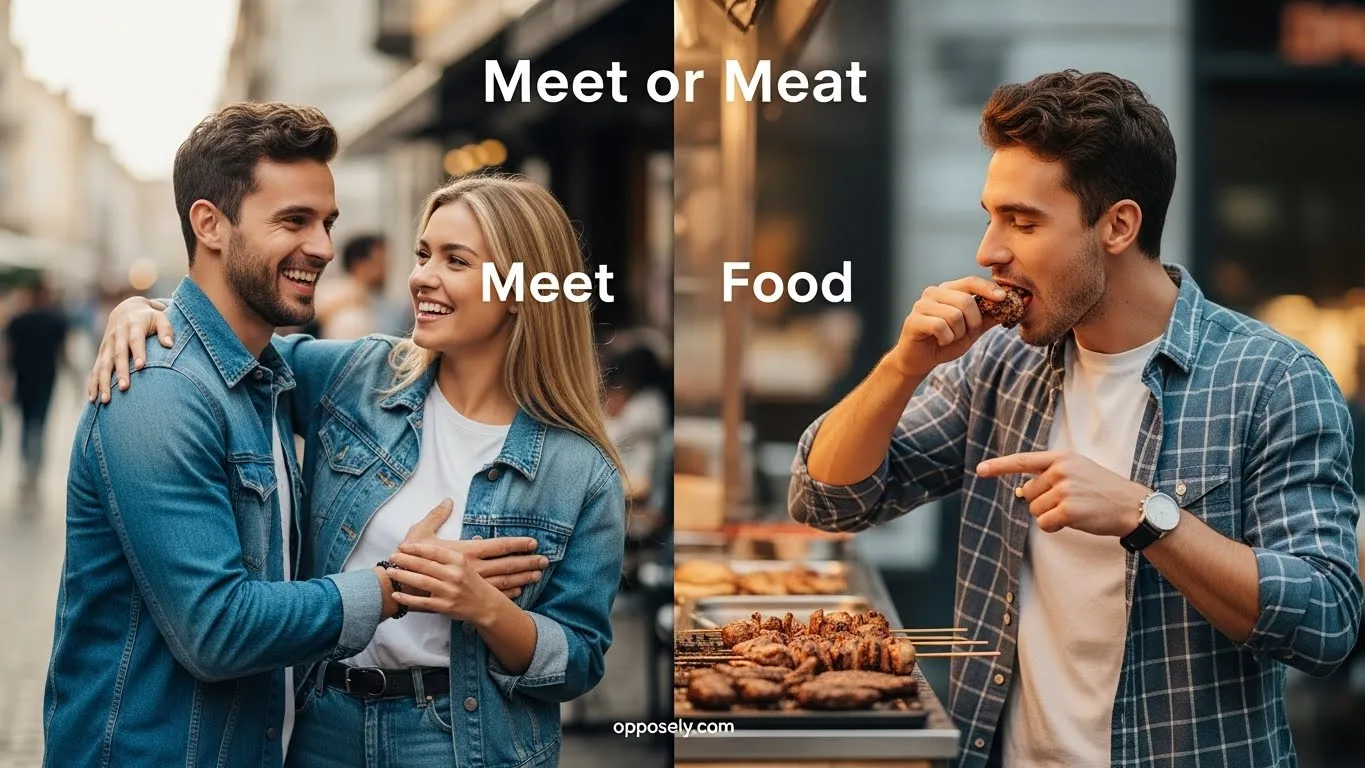
Have you ever paused while writing and wondered: should I write meet or meat? This common confusion affects English learners and even native speakers. Although these words sound the same, their meanings are completely different.
Using the wrong word can make your writing confusing, funny, or even unprofessional.
People search for meet or meat because they want to communicate clearly, whether in emails, social media, essays, or professional writing. Choosing the correct word ensures your message is accurate and your readers understand you.
In this article, we will explain the meanings, origins, British vs American usage, common mistakes, real-life examples, and tips for using meat or meetcorrectly.
By the end, you’ll confidently know when to use each word.
Meet or Meat: Quick Answer
- Meet → To encounter or come together with someone.
- Meat → The edible flesh of animals used as food.
Examples:
| Word | Correct Usage |
|---|---|
| Meet | I will meet my friend at the cafe. |
| Meat | I bought some fresh meat from the market. |
Remember: meet is about interaction or gathering, while meat is about food.
Meaning and Usage
Meet
Meet is a verb and can be used in several ways:
- To encounter someone:
- Example: “I will meet my teacher after class.”
- To come together for a purpose:
- Example: “The team will meet to discuss the project.”
- To fulfill or satisfy requirements:
- Example: “This solution meets all the customer’s needs.”
Meat
Meat is a noun:
- Animal flesh used as food:
- Example: “The recipe calls for 500 grams of meat.”
- Figurative use (substance of something):
- Example: “The meat of the discussion was about finances.”
Origin:
Meet
- Comes from Old English mētan, meaning “to encounter or come across.”
- Historically used to describe gatherings, meetings, and encounters.
- Continues to be widely used in modern English for both personal and professional contexts.
Meat
- Derived from Old English mete, meaning “food” or “nourishment.”
- Originally referred to all kinds of food, but over time it came to specifically mean the flesh of animals.
- Commonly used in cooking, recipes, restaurants, and food-related discussions.
British English vs American English Usage
Both meet and meat are spelled the same in British and American English. There is no regional spelling difference, but their proper usage is essential.
| Word | British English | American English |
|---|---|---|
| Meet | ✅ Same meaning | ✅ Same meaning |
| Meat | ✅ Same meaning | ✅ Same meaning |
The key is to use the word according to context, not just pronunciation.
Common Mistakes:
| Mistake | Correct Form | Explanation |
|---|---|---|
| “I will meat my friend.” | Meet | Using the food word instead of the verb. |
| “We need to meet some chicken for dinner.” | Meat | Confusing interaction verb with food noun. |
| Misspelling meat as “meat” in non-food contexts | Meet | Ensure proper usage in professional writing. |
| Using meet to describe food | Meat | Only animal flesh is meat. |
Always double-check the context to avoid these mistakes.
In Everyday Writing
Emails
- Meet: “Can we meet tomorrow to discuss the project?”
- Meat: “The cafeteria serves fresh meat sandwiches.”
Social Media
- Meet: “Excited to meet new friends at the event!”
- Meat: “Trying the best grilled meat in town today!”
News and Articles
- Meet: “The president will meet world leaders next week.”
- Meat: “The new law affects the import of meat products.”
Academic or Professional Writing
- Meet: “Students will meet their advisors for guidance.”
- Meat: “The meat of the experiment focused on protein analysis.”
Comparison Table:
| Feature | Meet | Meat |
|---|---|---|
| Part of speech | Verb | Noun |
| Meaning | Encounter, come together | Edible animal flesh |
| British English | ✅ Same | ✅ Same |
| American English | ✅ Same | ✅ Same |
| Common Mistake | Using for food | Using for meetings |
| Example | “I will meet my friend.” | “I cooked fresh meat for dinner.” |
Tips to Remember the Difference
- Meet = interaction, think about meeting people.
- Meat = food, think about eating.
- Context is key: are you talking about someone or something you eat?
- If unsure, replace the word with a synonym: “encounter” for meet, “food” for meat.
- Proofread emails, essays, and posts to avoid embarrassing mistakes.
FAQs:
1. Are meet and meat pronounced the same?
Yes, they are homophones, but their meanings are completely different.
2. Can meet be used as a noun?
Rarely. In some contexts, “meet” can refer to a sports event, like a “track meet.”
3. Can meat be used in non-food contexts?
Yes, figuratively, such as “the meat of the discussion,” meaning the main substance.
4. Is using meat instead of meet a common mistake?
Yes, especially in informal writing or among English learners.
5. How can I remember which to use?
Think: “I meet people, I eat meat.”
6. Are there British vs American differences?
No, both spellings and meanings are the same in both variants.
7. Can I use meet in professional writing?
Yes, it’s widely accepted for meetings, appointments, and discussions.
Conclusion
Confusion between meet or meat is common but easy to resolve. Meet is always about encountering or coming together with someone, while meat refers to the edible flesh of animals. Using the wrong word can create confusion, awkwardness, or misunderstandings in emails, essays, social media posts, and professional writing.
By understanding the origins, meanings, and proper usage of meat or meet, you can confidently write without mistakes. Always remember the context: are you talking about a person or food?
Mastering this simple distinction ensures your writing is clear, professional, and natural. Correct usage of meet vs meat improves clarity, credibility, and reader understanding across all types of communication.
Read More:
Breeched or Breached: Meaning, Usage and Examples
Platypuses or Platypi: Meaning, Usage and Examples
Rewinded or Rewound: Meaning, Mistakes and Examples