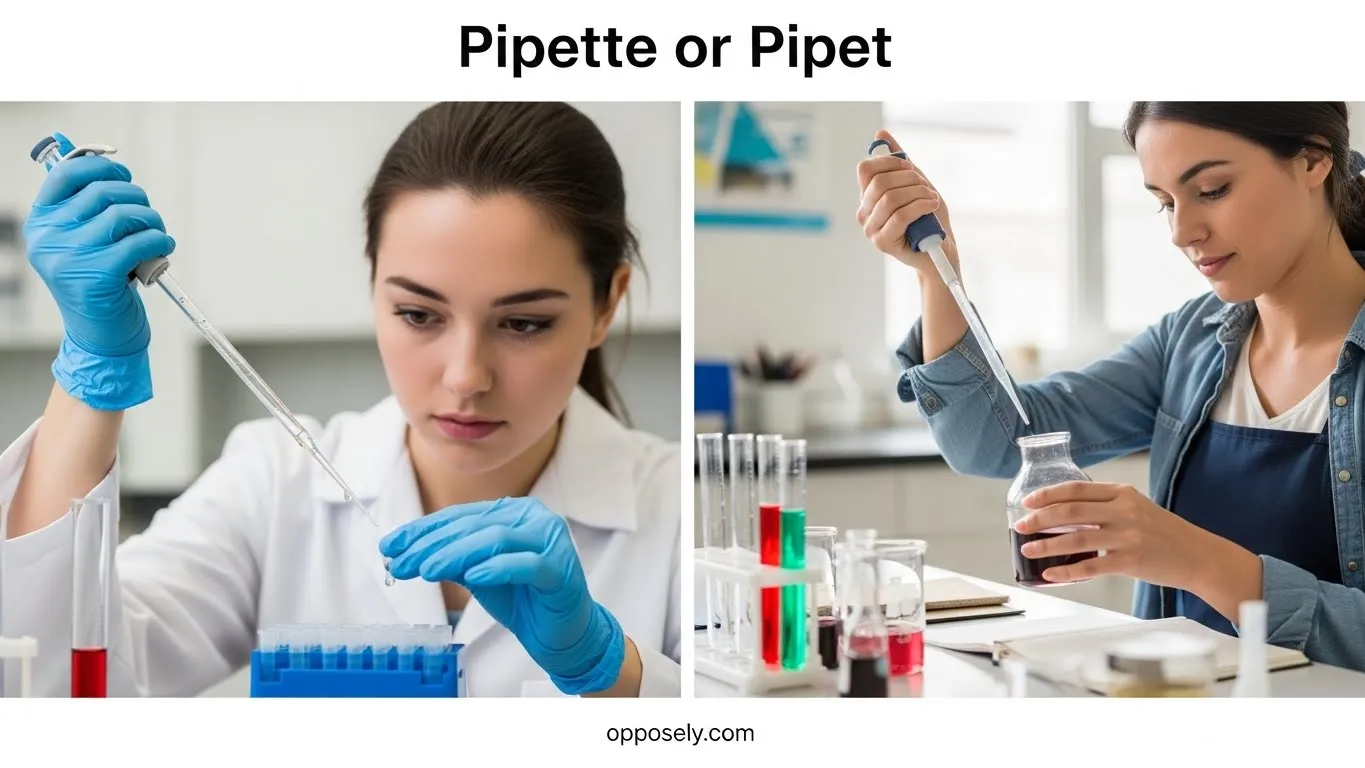
Have you ever wondered whether it’s pipette or pipet? You’re not alone. Both spellings refer to the same essential laboratory tool, but using the wrong one can confuse readers and make your writing look unprofessional.
Whether you’re a student, researcher, lab technician, or science blogger, understanding pipette or pipet is key to writing clearly and accurately.
In this article, we’ll explore their origins, differences between British and American English, common mistakes, real-life examples, and tips for correct usage. By the end, you’ll confidently choose the right term in any scientific or educational context.
Pipette or Pipet: Quick Answer
- Pipette – The correct spelling in British English and most formal scientific publications.
- Pipet – The American English variant, accepted in some journals and lab manuals.
Examples:
- British English: The researcher carefully filled the pipette with the solution.
- American English: The technician used a pipet to transfer the sample.
- Incorrect: The scientist used a pipette in a US journal that prefers pipet without clarification.
Tip: Both refer to the same laboratory tool used to measure or transfer liquids. The main difference is spelling preference depending on audience or publication.
The Origin of Pipette/Pipet
Pipette
- Derived from the French word “pipette”, which is a diminutive of “pipe”, meaning small tube.
- Adopted in English scientific language in the 19th century.
- Initially used in chemistry and biology laboratories for precise liquid measurements.
Pipet
- An Americanized form of pipette, simplified in spelling for practicality.
- Common in US textbooks, lab protocols, and journals that favor streamlined spelling.
- Became standard in several American scientific communities, though pipette remains universally recognized.
Key Insight: The difference is mostly regional spelling, not meaning.
British English vs American English
Both pipette and pipet are correct, but usage depends on the style guide or region.
| Word | Meaning | UK Usage | US Usage | Notes |
|---|---|---|---|---|
| Pipette | Small laboratory tool for liquids | Standard | Accepted | Most formal publications prefer this |
| Pipet | Same tool, US spelling variant | Rare | Common | Simplified American spelling |
Example Sentences:
- UK: Carefully insert the tip of the pipette into the sample.
- US: The student used a pipet to transfer 10 mL of solution.
Tip: Always check the journal, textbook, or lab manual you are following.
Which Spelling Should You Use?
- Pipette → Default choice for international, scientific, and formal writing.
- Pipet → Acceptable in American publications, US lab manuals, and informal settings.
Quick Rule: If your audience is global or your writing is formal, pipette is safer. For US-specific audiences, pipet works, but consistency is key.
Common Mistakes with Pipette/Pipet
- Mixing spellings in the same text
- ❌ The pipette was filled with water, then the pipet was used to transfer it.
- ✅ The pipette was filled with water, then the pipette was used to transfer it.
- Assuming one spelling is incorrect
- Both spellings are technically correct, depending on style or region.
- Using non-standard abbreviations
- ❌ Pip. or Ppt. can confuse readers; stick to full spelling unless a journal allows abbreviations.
- Not following lab manual conventions
- Lab protocols may require consistent spelling for clarity and compliance.
Pipette/Pipet in Real-Life Examples
1. Laboratory Work
- The scientist carefully drew 5 mL of reagent into the pipette to ensure accurate measurement.
- Using a pipet, the lab technician transferred blood samples into separate test tubes.
2. Academic Papers
- The study used a glass pipette to deliver the solution drop by drop.
- All measurements were taken using calibrated pipets according to US protocol.
3. Educational Settings
- Students practiced proper pipette technique during the chemistry lab session.
- The teacher demonstrated how to handle a pipet without introducing bubbles.
4. Online Tutorials & Blogs
- Learn how to use a pipette like a professional scientist.
- Here’s a step-by-step guide to handling a pipet in your home lab.
Google Trends & Usage Data
- Pipette dominates global searches due to its prevalence in scientific literature and formal publications.
- Pipet is mostly searched in the US context and in educational content.
Trends Table:
| Word | Popular Searches | Context |
|---|---|---|
| Pipette | Lab tutorials, research papers | International, formal |
| Pipet | US lab manuals, student guides | American-specific usage |
Insight: If your audience is global or academic, pipette will improve searchability and professionalism.
Keyword Variations Comparison
| Variation | Correct? | Notes |
|---|---|---|
| Pipette | ✅ | Standard international spelling |
| Pipet | ✅ | US spelling variant |
| Pipettes | ✅ | Plural form of pipette |
| Pipets | ✅ | Plural form of pipet |
| pipeting | ✅ | Verb form in US manuals |
| pipetting | ✅ | Verb form internationally |
Tip: Use plural and verb forms consistently according to the spelling you chose.
Advanced Tips for Using Pipette/Pipet
- In Writing
- Stick to one spelling throughout your text.
- Use pipette for formal research papers, journal articles, or international publications.
- In Labs
- Use the spelling consistent with your lab manual to avoid confusion.
- Proper technique description is more important than spelling in oral instructions.
- In Blogs or Educational Content
- Explain both spellings briefly to help readers understand the difference.
- Example: “In the US, some manuals use pipet, but pipette is widely accepted internationally.”
- SEO & Online Content
- Pair keywords with context: “how to use a pipette,” “pipet lab techniques,” “pipette vs pipet guide.”
FAQs:
Q1: Are pipette and pipet the same tool?
- ✅ Yes, only the spelling differs.
Q2: Which is correct for scientific papers?
- ✅ Pipette is safer for international publications.
Q3: Can I use pipet in US journals?
- ✅ Yes, it’s widely accepted.
Q4: How do I remember the difference?
- Think: Pipette = French origin, formal; Pipet = Americanized spelling.
Q5: Are plural forms different?
- ✅ Pipettes (international), Pipets (US).
Conclusion
Let’s be honest: confusing pipette and pipet doesn’t mean your scientific knowledge is weak. It just shows that English spelling can be tricky, especially with words borrowed from French.
Now you know the truth: pipette is the international, formal choice, while pipet is an accepted American variant.
Next time you write a research paper, lab report, blog, or tutorial, type pipette or pipet with confidence 💪 No second-guessing.
Small details like this make your writing more professional and precise. Whether it’s describing a precise lab measurement with a pipette or a US protocol using a pipet, your readers will immediately trust your work.
Read More:
Habbit or Habit? Origin, Usage, and Spelling Errors
Crummy or Crumby: Meaning, Origin & Examples
Die or Dye? Comparison, Examples, and Rules