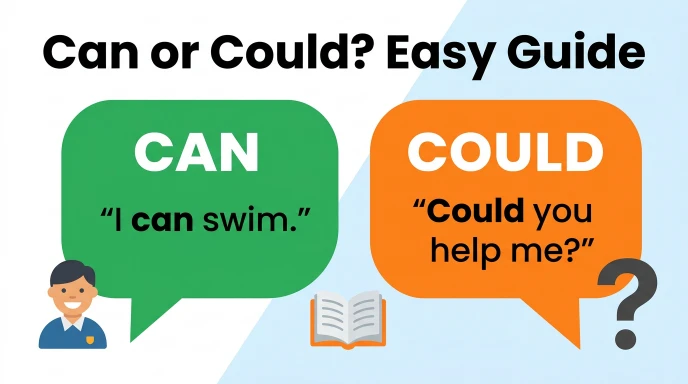
Can = ability or permission now; Could = past ability or a more polite request/possibility
.Many English learners and writers search for “can or could” because these two words look similar but have different uses. They are both modal verbs, and both talk about ability, possibility, permission, or requests. Yet choosing the right one can be confusing.
For example, should you say, “Can you help me?” or “Could you help me?” Both sound correct, but they create different tones. One is direct, while the other is more polite.
This confusion affects students, professionals, content writers, and anyone learning English. Using the wrong word can make a sentence sound too casual, too formal, or even grammatically incorrect.
This guide explains the difference between can and could in simple language. You will learn their meanings, origins, spelling facts, common mistakes, and real-life examples. By the end, you will know exactly when to use can and when to use could.
Can or Could : Quick Answer
Can is used for present ability, permission, and possibility.
Could is usually used for past ability, polite requests, and uncertain possibilities.
Examples
- I can swim. (Present ability)
- She can leave early today. (Permission)
- I could swim when I was five. (Past ability)
- Could you help me with this report? (Polite request)
- It could rain later. (Possible event)
Simple Rule
- Use can for things that are true now.
- Use could for things in the past or when you want to sound more polite.
The Origin of Can or Could
The word can comes from the Old English word cunnan, which meant “to know” or “to be able to.”
The word could developed as the past tense form of can. Over time, English speakers also began using could to express politeness and possibility.
Unlike many English words, there are no spelling variations between British and American English for can and could. The spelling remains the same worldwide.
Why Do People Confuse Them?
People often confuse can and could because both refer to ability and possibility. However, the level of certainty and time reference is different.
British English vs American English Spelling
For can and could, there is no spelling difference between British English and American English.
Both varieties use the same spelling and meaning.
Comparison
| Feature | British English | American English |
| Can | Can | Can |
| Could | Could | Could |
| Present Ability | Can | Can |
| Past Ability | Could | Could |
| Polite Request | Could | Could |
| Permission | Can | Can |
Examples
- UK: Can I borrow your pen?
- US: Can I borrow your pen?
- UK: Could you open the window?
- US: Could you open the window?
The spelling and usage remain nearly identical.
Which Spelling Should You Use?
Since there is no spelling difference, you can use the same words in all English-speaking regions.
For US Audiences
- Use can for present ability.
- Use could for past ability and polite requests.
For UK and Commonwealth Audiences
- The same rules apply.
- Could is often preferred in formal and polite communication.
For Global Audiences
- Follow standard grammar rules.
- Choose based on meaning rather than location.
Common Mistakes with Can or Could
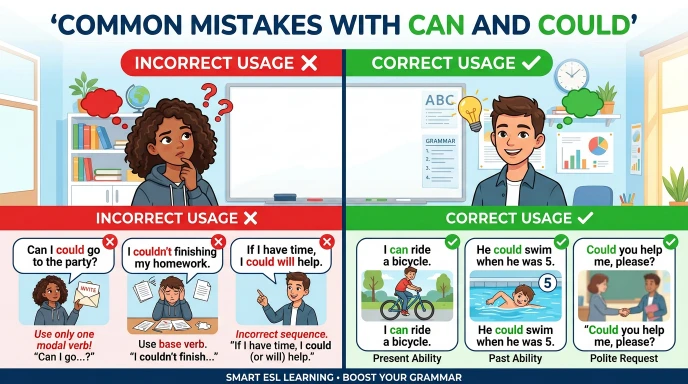
Mistake 1: Using Could for Current Ability
❌ I could speak English fluently now.
✅ I can speak English fluently now.
Mistake 2: Using Can for Past Ability
❌ When I was six, I can ride a bike.
✅ When I was six, I could ride a bike.
Mistake 3: Using Can in Very Formal Requests
❌ Can you please provide the report, sir?
✅ Could you please provide the report, sir?
Mistake 4: Confusing Possibility Levels
❌ It can rain tomorrow. (When discussing uncertainty)
✅ It could rain tomorrow.
Can or Could in Everyday Examples
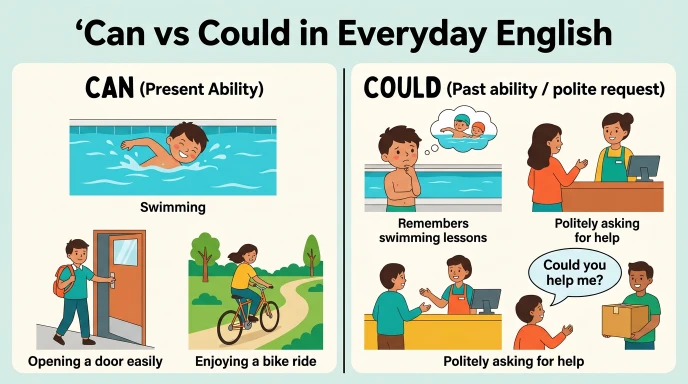
In Emails
- Can you send the file today?
- Could you send the file today, please?
In News Writing
- The company can increase production next year.
- The new policy could affect thousands of workers.
On Social Media
- I can finally travel again!
- This update could change everything.
In Formal Writing
- The system can process large amounts of data.
- The results could indicate a new trend.
Can or Could : Google Trends & Usage Data
Search interest for can or could remains strong because learners frequently struggle with modal verbs.
Popular Countries
The topic is commonly searched in:
- India
- Pakistan
- United States
- United Kingdom
- Canada
- Australia
Common Search Contexts
People often search:
- Can vs could
- Difference between can and could
- Can and could examples
- Can or could in requests
- Can or could grammar rules
Usage Comparison
| Usage Type | Can | Could |
| Present Ability | Yes | No |
| Past Ability | No | Yes |
| Permission | Yes | Sometimes |
| Polite Request | Sometimes | Yes |
| Possibility | Yes | Yes |
| Formal Tone | Moderate | Strong |
| Everyday Conversation | Very Common | Common |
FAQs
1. What is the main difference between can and could?
Can refers to present ability or permission. Could usually refers to past ability or polite requests.
2. Is could the past tense of can?
Yes. Traditionally, could is the past tense form of can.
3. Which is more polite, can or could?
Could is generally more polite and formal.
4. Can I use could for future events?
Yes. Could can express future possibility.
Example: It could snow tomorrow.
5. Is can stronger than could?
Yes. Can often expresses greater certainty.
6. Can and could both be used for requests?
Yes. However, could sounds more polite.
7. Are can and could spelled differently in British English?
No. The spelling is identical in British and American English.
Conclusion
Understanding can or could is important for clear and natural English communication. While both words are modal verbs, they serve different purposes. Can is usually used for present ability, permission, and situations that feel more certain. Could is commonly used for past ability, polite requests, and possibilities that are less certain.
The good news is that there are no spelling differences between British English and American English. This makes usage easier because the choice depends on meaning rather than location.
When speaking casually, can often works well. In professional or formal situations, could is usually the better option because it sounds more respectful and polite. Remember the simple rule: use can for what is possible now and could for past ability, polite requests, or uncertain possibilities.
By practicing these rules and examples, you can confidently choose the correct word in conversations, emails, academic writing, and professional communication.
Read more about!
x64 or ARM64: Which Architecture Should You Choose?
Benzocaine or Lidocaine: Uses, Safety, and Tips

I am Sarah Williams, an English grammar writer and content creator. I write simple and easy articles to help people learn English grammar in a better way.
My goal is to make English learning easy and understandable for everyone. I explain grammar rules in a clear and simple way so that students, bloggers, and beginners can easily understand and improve their skills.
I focus on creating helpful and practical content that improves writing, speaking, and communication skills.