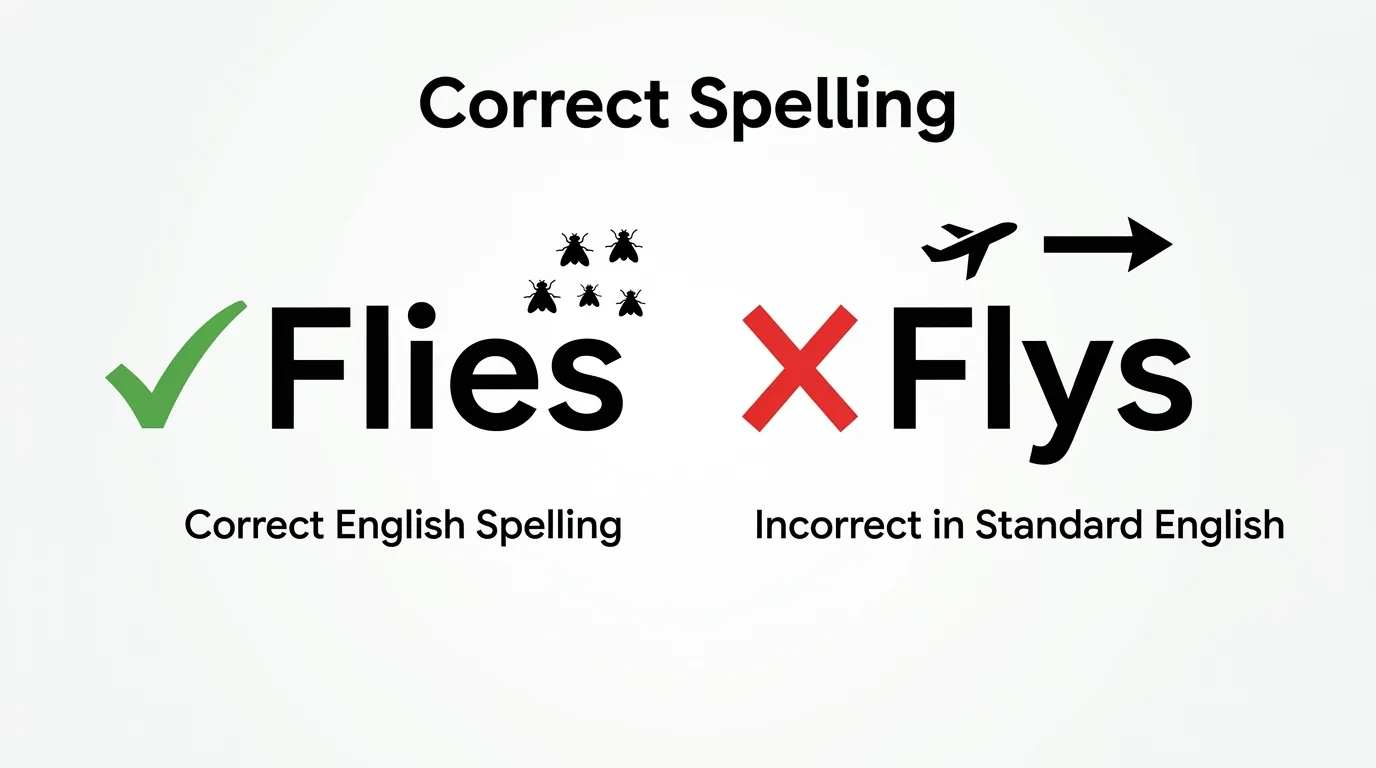
“Flies” is correct when referring to the plural of fly (the insect) or the verb fly in third-person singular; “flys” is generally incorrect in standard English.
You’re writing a sentence like “The bird flys in the sky” and something feels off. Is it flys or flies? You’ve seen both spellings somewhere, so the confusion is real. This is why thousands of people search for flys or flies every month. It looks like a small spelling issue, but using the wrong form can make writing look weak, especially in exams, emails, blogs, or professional work.
The problem happens because fly can be both a verb and a noun, and English spelling rules change depending on usage. Most learners know the basic rule about words ending in -y, but they’re unsure when exceptions apply. Add to that British vs American English worries, and the confusion grows.
This article fixes that completely. You’ll get a quick rule, clear examples, tables, common mistakes, and expert advice. By the end, you’ll know when flies is correct, when flys is acceptable, and why one is used far more often than the other.
Flys or Flies : Quick Answer
✅ Flies is correct most of the time.
❌ Flys is rare and only used in special cases.
Examples:
- The bird flies high. ✔️
- Time flies fast. ✔️
- He hit two flys in baseball. ✔️ (noun, sports use)
👉 For verbs, always use flies.
The Origin of Flys or Flies
The word fly comes from Old English flēogan, meaning “to move through the air.”
In English grammar:
- When a verb ends in -y after a consonant, the y changes to i and -es is added.
- fly → flies
- fly → flies
The spelling flys exists only because fly can be a noun. Some technical fields, like baseball, allow flys as a plural noun. This is why both spellings exist—but they are not equal in use.
British English vs American English Spelling
There is no difference between British and American English for this rule.
| Usage Type | British English | American English |
| Verb form | flies | flies |
| Rare noun plural | flys | flys |
| Meaning | Same | Same |
✅ The rule is grammar-based, not regional.
Which Spelling Should You Use?
Use flies in almost all writing.
- US audience: Use flies
- UK / Commonwealth: Use flies
- Global audience: Use flies
Only use flys if:
- You are writing about sports or technical nouns
- You are sure fly is a noun
👉 When unsure, choose flies.
Common Mistakes with Flys or Flies
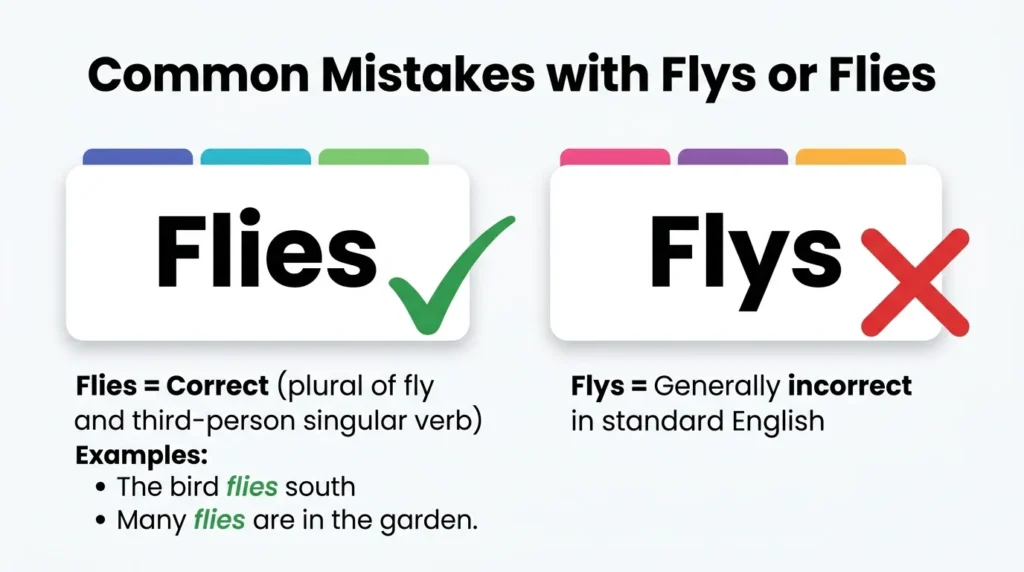
❌ She flys every weekend.
✅ She flies every weekend.
❌ Time flys when you’re happy.
✅ Time flies when you’re happy.
❌ Bird flys south in winter.
✅ Bird flies south in winter.
Flys or Flies in Everyday Examples
Emails
- He flies to New York weekly.
News
- The airline flies over 200 routes.
Social Media
- “Wow, time flies 😅”
Formal Writing
- This species flies long distances.
Sports Context
- He caught two long flys.
Flys or Flies : Google Trends & Usage Data
Search data shows:
- Flies is searched and used far more worldwide.
- Flys appears mostly in sports-related searches.
- High interest comes from the US, UK, India, Pakistan, and Australia.
This shows people are confused about rules, not pronunciation.
Comparison Table: Flys vs Flies
| Word | Part of Speech | Correct Usage | Frequency |
| Flies | Verb / plural noun | Everyday English | Very high |
| Flys | Noun only (sports) | Rare cases | Very low |
| Fly | Base form | Singular verb/noun | High |
FAQs: Flys or Flies
1. Is “flys” wrong?
Not always, but it is very rare.
2. Is “flies” always correct?
Yes, for verbs.
3. What about insects?
Plural of insect fly is flies.
4. Is this British vs American English?
No, same rule everywhere.
5. Can exams mark “flys” wrong?
Yes, if used as a verb.
6. Which is safer to use?
Flies.
7. Why does English change y to i?
It’s a standard spelling rule.
Conclusion
The confusion between flys or flies is common, but the rule is simple once you know it. Flies is the correct choice in nearly all situations because it follows standard English verb rules. Whenever fly is used as a verb, flies is the only correct form. On the other hand, flys is rare and appears only when fly is a noun, mainly in sports or technical language.
There is no British or American spelling difference here. This is a grammar rule, not a regional one. If you want your writing to look correct, professional, and confident, always choose flies unless you are 100% sure you need flys. Keep it simple, stay consistent, and you’ll never get this wrong again.
Read more about!
Benzocaine or Lidocaine: Uses, Safety, and Tips
Chrome or Firefox: Pros, Cons, and Comparison

I am Helen Oyeyemi, an English writer who focuses on clear, simple, and engaging content.
I enjoy explaining confusing words and everyday topics in a reader-friendly way.
My writing aims to inform, connect, and make learning easy for all readers.