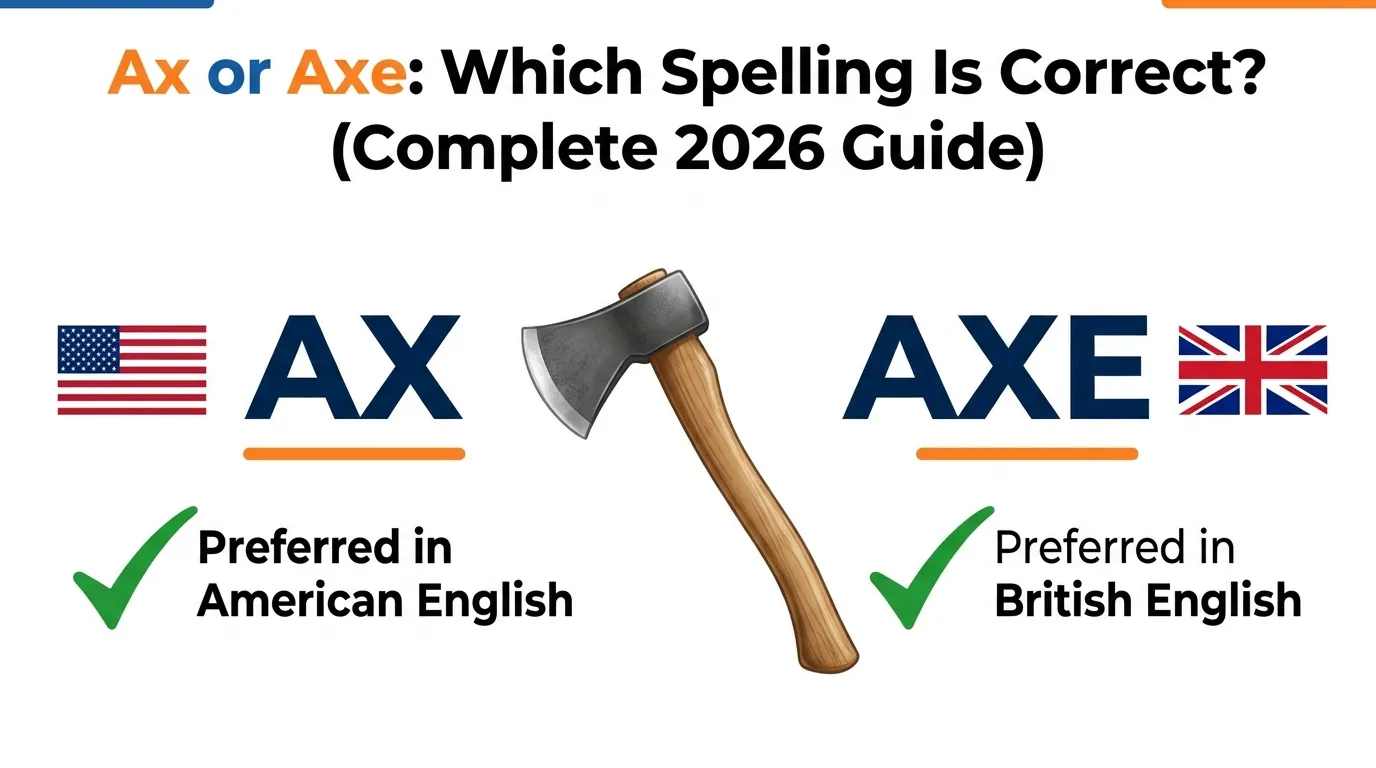
Both “ax” and “axe” are correct; “axe” is more common in British English, while “ax” is the preferred spelling in American English.
You’re writing a sentence like “He picked up an ax” or should it be “axe”? You pause, reread it, and suddenly you’re unsure. This exact moment is why so many people search for ax or axe. Both spellings appear in books, news, movies, and online posts. Both look correct. So why do two spellings exist for the same word?
The confusion happens because ax and axe are regional spellings, not different words. Add to that the fact that ax/axe can be both a noun (a tool) and a verb (to cut or remove), and things feel even more unclear. Students worry about exams, writers worry about professionalism, and bloggers worry about if and audience.
This article clears everything up. You’ll get a quick answer, simple rules, history, regional differences, tables, real-life examples, common mistakes, and expert advice. By the end, you’ll know exactly when to use ax and when to use axe, without second-guessing.
Ax or Axe :f Quick Answer
Both spellings are correct.
- Ax → American English
- Axe → British English (and Commonwealth)
Examples:
- He swung the ax to cut wood. (US)
- She sharpened her axe before hiking. (UK)
👉 Same meaning. Same pronunciation. Different regional spelling.
The Origin of Ax or Axe
The word comes from Old English æx and eax, meaning a cutting tool. In early English, both spellings existed at the same time. There was never just one “correct” version.
As English evolved:
- British English kept the axe spelling.
- American English preferred the shorter form ax, following its tendency to simplify spellings (like color vs colour).
Because both spellings are historically valid, neither is wrong. The difference exists due to regional spelling preferences, not grammar or meaning.
British English vs American English Spelling
This is a classic US vs UK spelling difference.
| Usage | American English | British English |
| Tool (noun) | ax | axe |
| To cut/remove (verb) | ax | axe |
| Idioms | ax to grind | axe to grind |
| Meaning | Same | Same |
✅ Choose based on your audience.
Which Spelling Should You Use?
Pick the spelling that matches who you are writing for.
Audience-based advice:
- US audience: Use ax
- UK, Australia, Canada: Use axe
- Global audience: Choose one style and stay consistent
If tip:
If your site uses American spelling (color, center), use ax.
If it uses British spelling (colour, centre), use axe.
Common Mistakes with Ax or Axe
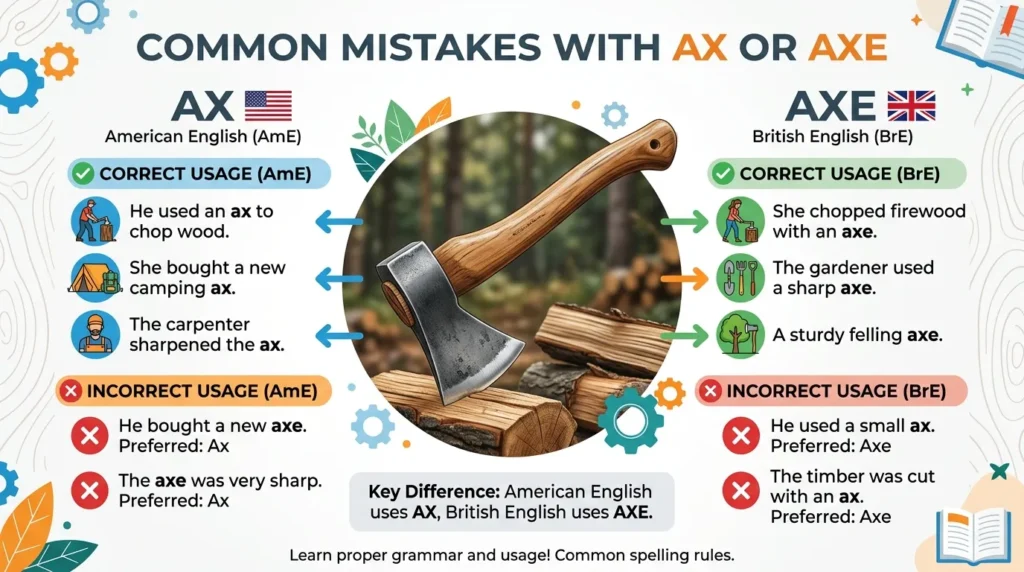
❌ Mixing spellings in the same article
✅ Use only one version
❌ Thinking one spelling is incorrect
✅ Both are correct regionally
❌ He axed the tree (UK formal writing)
✅ He axed/axed the tree → axed is also acceptable
⚠️ Note:
Past tense can be axed in both styles, though axed is more common than axed vs axed debates.
Ax or Axe in Everyday Examples
Emails
- “The company may ax the project.” (US)
- “The company may axe the project.” (UK)
News
- “Jobs were axed during restructuring.”
- “He carried an axe while camping.”
Social Media
- “They might ax this feature 😬”
- “Bought a new axe for hiking 🪵”
Formal Writing
- “The proposal was axed due to budget limits.”
- “An axe was used as a historical tool.”
Ax or Axe :Google Trends & Usage Data
Search trends show:
- Ax is searched more in the United States.
- Axe dominates in the UK, Australia, and India.
- Both are searched globally, often with “difference” or “correct spelling.”
- Searches increase during writing, exam, and content-creation seasons.
This confirms users are confused about regional spelling, not meaning.
Comparison Table: Ax vs Axe
| Feature | Ax | Axe |
| English type | American | British |
| Part of speech | Noun & verb | Noun & verb |
| Meaning | Cutting tool / remove | Same |
| Correct usage | Yes | Yes |
| Global acceptance | High | High |
FAQs: Ax or Axe
1. Is “ax” wrong English?
No, it’s correct in American English.
2. Is “axe” more formal?
No, it’s just British spelling.
3. Can I use ax as a verb?
Yes, in American English.
4. What about the idiom “axe to grind”?
US uses ax, UK uses axe.
5. Which spelling should students use in exams?
Use the spelling taught in your region.
6. Is the pronunciation different?
No, both sound the same.
7. Which is better for global writing?
Either just stay consistent.
Conclusion
The difference between ax or axe is simple once you see the pattern. Both spellings are correct. Both mean the same thing. Both are pronounced the same way. The only difference is region. American English prefers ax, while British and Commonwealth English prefer axe.
There is no grammar issue here, no right-or-wrong battle, and no change in meaning. What matters most is consistency. Choose the spelling that matches your audience and stick with it throughout your writing. Doing this makes your content look polished, professional, and confident.
If you remember one rule, remember this: ax for American, axe for British. With that in mind, you’ll never be confused about ax or axe again.
Read more about!
Asana or Trello: Features, Pricing, and Ease of Use
Incorporate or LLC: Pros, Cons, and Costs

I am Helen Oyeyemi, an English writer who focuses on clear, simple, and engaging content.
I enjoy explaining confusing words and everyday topics in a reader-friendly way.
My writing aims to inform, connect, and make learning easy for all readers.