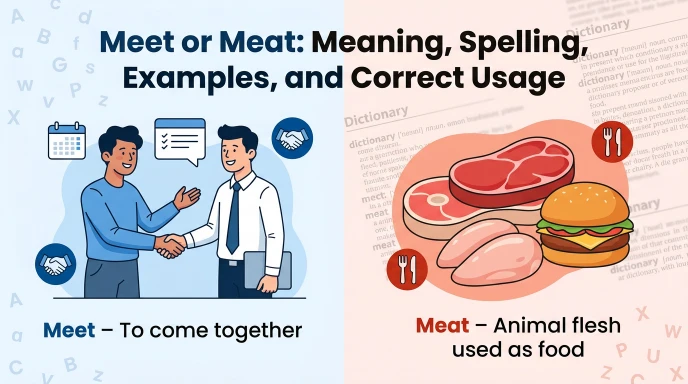
Meet means to come together or see someone, while meat means the flesh of animals used as food.
Have you ever typed “meet or meat” and stopped to think if you picked the right word? You are not alone. These two words sound exactly the same, but they have very different meanings. Because they are pronounced alike, many people confuse them in writing.
People search for “meet or meat” to learn which word fits their sentence. Students, writers, English learners, and professionals often want a quick answer before sending an email, writing an article, or posting on social media
. Using the wrong word can completely change the meaning of a sentence. For example, “Let’s meat tomorrow” is incorrect, while “Let’s meet tomorrow” is correct. Likewise, “I bought fresh meet” should be “I bought fresh meat.”
This guide explains the difference in simple language. You will learn the meaning, history, spelling rules, examples, common mistakes, and when to use each word. By the end, you will know exactly which word to choose every time.
Meet or Meat : Quick Answer
Meet is a verb. It means to come together with someone or something.
Examples:
- Let’s meet at the café.
- I want to meet my new teacher.
- They will meet next week.
Meat is a noun. It means the edible flesh of animals used as food.
Examples:
- We bought fresh meat.
- Chicken is my favorite meat.
- The store sells organic meat.
Quick Comparison
| Word | Part of Speech | Meaning | Example |
| Meet | Verb | To come together | We will meet tomorrow. |
| Meat | Noun | Animal flesh used as food | The meat is fresh. |
The Origin of Meet or Meat
Although meet and meat sound the same today, they come from different Old English words.
Meet comes from the Old English word mētan, meaning “to encounter” or “come together.”
Meat comes from the Old English word mete, which originally meant “food” in general. Over time, its meaning became more specific and now refers to animal flesh eaten as food.
The spelling stayed different because the words developed from different roots, even though their pronunciation became almost identical over many centuries.
British English vs American English Spelling
Unlike many English words, meet and meat are spelled the same in both British and American English.
The difference is meaning, not regional spelling.
Examples
British English
- Shall we meet after work?
- They bought fresh meat from the butcher.
American English
- Let’s meet at noon.
- The restaurant serves grilled meat.
Comparison Table
| Feature | Meet | Meat |
| British English | Meet | Meat |
| American English | Meet | Meat |
| Pronunciation | Same | Same |
| Meaning | Come together | Animal food |
Which Spelling Should You Use?
The correct choice depends on what you want to say.
Use Meet if:
- You are talking about seeing someone.
- You are discussing introductions.
- You mean coming together.
Use Meat if:
- You are talking about food.
- You are referring to beef, chicken, lamb, or other animal products.
- You are writing recipes or restaurant menus.
Audience Guide
| Audience | Recommended Word |
| US readers | Meet or Meat (based on meaning) |
| UK readers | Meet or Meat (based on meaning) |
| Australia, Canada, New Zealand | Meet or Meat (based on meaning) |
| Global audience | Use the word that matches your intended meaning |
Common Mistakes with Meet or Meat
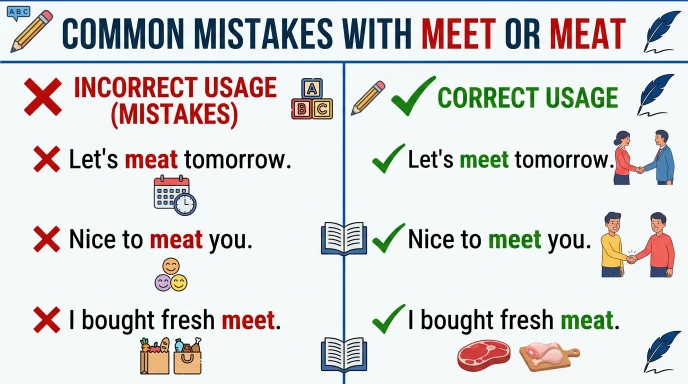
Here are mistakes people often make.
Incorrect
Let’s meat tomorrow.
Correct
Let’s meet tomorrow.
Incorrect
I cooked some meet for dinner.
Correct
I cooked some meat for dinner.
Incorrect
Nice to meat you.
Correct
Nice to meet you.
Incorrect
The shop sells fresh meet.
Correct
The shop sells fresh meat.
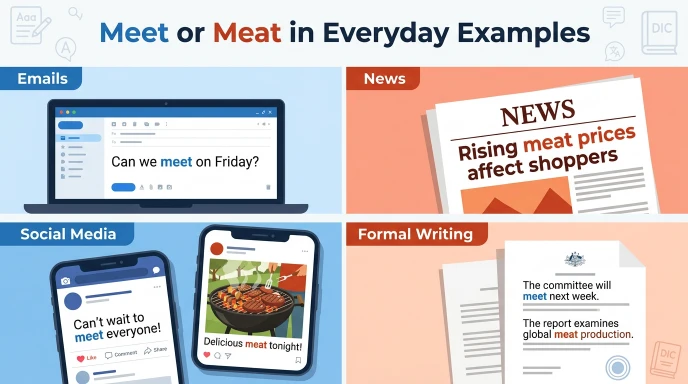
Meet or Meat in Everyday Examples
Emails
- Can we meet on Friday?
- We will meet online at 2 PM.
News
- The company will meet investors next month.
- Rising meat prices affect shoppers.
Social Media
- Can’t wait to meet everyone!
- BBQ night with lots of delicious meat.
Formal Writing
- The committee will meet to discuss the proposal.
- The report studies global meat production.
Meet or Meat : Google Trends & Usage Data
Search interest in meet or meat stays steady because many English learners search for the correct word.
The confusion is common in:
- United States
- United Kingdom
- Canada
- Australia
- India
- Pakistan
- South Africa
People usually search these words when:
- Writing emails
- Completing homework
- Preparing for English exams
- Editing business documents
- Learning English pronunciation
Keyword Comparison Table
| Keyword Variation | Meaning | Search Intent |
| meet or meat | Difference between the words | Educational |
| meet vs meat | Word comparison | Grammar |
| meet meaning | Definition of meet | Vocabulary |
| meat meaning | Definition of meat | Vocabulary |
| meet examples | Sentence usage | Learning |
| meat examples | Food-related usage | Learning |
Frequently Asked Questions
1. Is it “meet” or “meat” someone?
Use meet when talking about seeing or greeting someone.
2. What does “meat” mean?
Meat means the edible flesh of animals used as food.
3. Why do meet and meat sound the same?
They are homophones. They have different meanings but share the same pronunciation.
4. Is “Nice to meat you” correct?
No. The correct phrase is “Nice to meet you.”
5. Are meet and meat spelled differently in the UK?
No. British and American English use the same spellings.
6. Which word is a verb?
Meet is the verb.
7. Which word is a noun?
Meat is the noun.
Conclusion
Understanding the difference between meet or meat is simple once you know their meanings. Meet is a verb that means to come together, greet someone, or have an appointment.
Meat is a noun that refers to animal flesh used as food. Even though the words sound exactly alike, they should never be used interchangeably because each has its own purpose.
The good news is that there is no difference between British and American English spelling for these words. You only need to choose the one that matches your meaning. If your sentence is about people coming together, use meet. If your sentence is about food, use meat. Reading your sentence aloud and asking yourself if you are talking about a person or food is an easy way to avoid mistakes.
With regular practice and careful proofreading, you can confidently use meet and meat correctly in emails, school assignments, business writing, social media posts, and everyday conversations.
Read more about!

am Michael Chabon, a dedicated English-language writer with a strong, polished literary voice and a deep respect for language.
My writing blends clarity, creativity, and insight, transforming ideas into engaging narratives that feel both intelligent and accessible.
With a professional approach and an eye for detail, I strive to produce work that leaves a lasting impression and earns genuine appreciation from readers.